Your customers are starting their search inside AI now, not on Google. They ask ChatGPT, Perplexity, or Google's own AI answers who to hire, and the tool names a few businesses and explains why each one fits. Discovery has shifted from a page of links people scroll and sort to a single recommendation they already trust before they ever reach your website.
This changes what it takes to get found. The old game rewarded whoever ranked highest or shouted loudest. The new one rewards the business whose expertise is clearest and best documented, because that is what an AI engine can actually read, trust, and repeat. The work now is making sure that when someone asks AI for a business like yours, the answer is you.
- AI-first discovery means many buyers now ask an AI engine who to hire before they ever open Google or visit a website.
- Recommendation over ranking is the shift: AI names a short, reasoned list instead of returning ten links for the buyer to sort through.
- Structured, well-sourced content is what AI engines read to decide who to recommend, so clear documentation now beats reputation alone.
- The clearest business wins, not the biggest: a well-documented small firm can get named ahead of a famous competitor with a thin website.
- Invisibility to AI is a silent leak, costing an established owner introductions they never see and never get the chance to win.
Find Out What AI Says About You
Request an AI Visibility Scan and see whether AI recommends you, a competitor, or no one yet, and why. Reviewed and sent by hand, not a self-serve tool.
Request my AI Visibility ScanReady to talk? Book a Rapid Transformation Call.
What actually changed about how customers discover businesses?
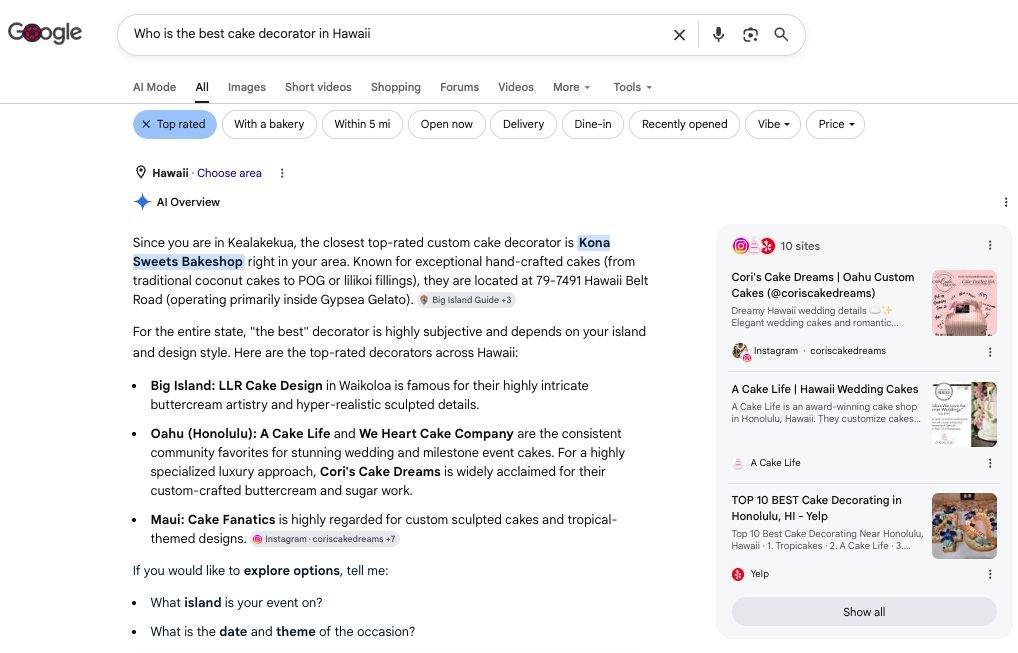
What changed is the middle step. For twenty years a customer typed a query, scanned a page of links, and chose for themselves. Now an AI engine reads the web and hands back a short answer with a few names already chosen, and the customer often acts on it without visiting a single site.
Three things shifted at once:
- The search moved into AI tools. People ask ChatGPT, Perplexity, and Google's own AI answers instead of scrolling a results page.
- The answer replaced the list. Most searches now end without a click. SparkToro found that in 2026, fewer than one in three Google searches sends a visitor to any website.
- The buyer arrives pre-sold. When AI names you and explains why, the person reaches you already trusting the recommendation.
How is an AI recommendation different from a Google search result?
An AI recommendation hands the customer a decision, while a Google result hands them a research project. Google returns ten links and expects the person to compare them. AI engines name two or three businesses, say why each fits, and let the buyer act on one synthesized answer.
| Google search | AI recommendation |
|---|---|
| Ten links to compare | A short list, already filtered |
| You judge what fits | The AI judges fit and explains it |
| Rewards links and age | Rewards clarity it can read |
| The click is the goal | The answer is the goal, the click is optional |
This matters because the answer increasingly ends the search. By early 2026, the majority of Google searches resolved without a single click.
Which AI tools are my customers actually using to find businesses?
Your customers use a handful of tools, and which one matters depends on the question. ChatGPT is the default for most people. Perplexity is favored by researchers who want sources. Google's AI answers reach anyone searching normally. Gemini and Copilot ride along inside Google and Microsoft accounts.
Why you cannot just pick one
Each engine reads a largely different slice of the web. One analysis of 680 million AI citations found each engine leaning on different favorites: Wikipedia dominates ChatGPT's top sources, Google's AI answers lean on Reddit and YouTube, and Reddit alone is nearly half of Perplexity's top-ten citation share. Being visible in one is no guarantee in another. The work that earns visibility, clear and well-documented expertise, is what carries across all of them.
What makes an AI engine recommend one business over another?
AI engines recommend the business whose expertise is clearest, best documented, and most confirmed by other sources. They are not counting backlinks or rewarding the biggest ad budget. They are reading for a clean answer to the exact question, from a source the rest of the web also points to.
In rough order of weight in 2026:
- A verifiable identity behind the content, a real person and business the engine can confirm across the web.
- Mentions on sites you do not own, like Reddit, LinkedIn, podcasts, and articles. Off-site mentions track more closely with AI visibility than backlinks do.
- Freshness. AI-cited content runs measurably younger than what wins the classic rankings, about a quarter younger in one 2026 study.
- Answer-first, structured content the engine can lift cleanly.
How do I find out what AI currently says about my business?
Find out in about ten minutes: open the AI tools your clients use and ask them the questions your clients ask. You are checking three things, whether you get named, whether a competitor gets named instead, and what the AI gets right or wrong about you.
Do this:
- In ChatGPT and Perplexity, ask "who are the best [your category] for [your kind of client]?"
- Ask a follow-up: "tell me about [your name or business]." See what it knows.
- Screenshot every answer, and note who got named and why.
- Repeat monthly. Perplexity and ChatGPT refresh what they cite constantly, so last quarter's answer about you may already be different.
This is the same first move our free AI Visibility Scan automates, on a larger scale.
I want to be honest about what this shift actually asks of you, because it is not what most of the AI advice out there is selling. The reflex is to treat AI as one more channel to feed, one more place to perform, and that reflex is backward. AI engines recommend the businesses they can clearly understand, not the ones that simply post the most. Clarity is the lever here, and almost no one is pulling it.
I have watched a client get handed a referral by ChatGPT she never advertised for and never chased, the kind of introduction that once took years to earn. It did not happen because she gamed an algorithm. It happened because her expertise was documented in a way the engine could read, trust, and repeat to a stranger who asked for exactly what she does.
That is the whole game now. When someone asks an AI who to hire, it assembles the answer from what it can find and verify about you across the web: structured, current, and confirmed by sources beyond your own site. So the work is not to chase visibility. It is to make your expertise so legible to these systems that the recommendation is already built around you. Do that, and you stop shouting to be found. Your expertise speaks, and the AI carries it.
 Cindy Anne Molchany · Founder
No. Traditional SEO competes for a ranking position on a page of links. Getting recommended by AI competes to be the named answer inside the AI's response, which often replaces the page of links entirely. The skills overlap, and structured content helps both, but the goal is different. You are optimizing to be cited and recommended, not only to rank.
Aim for the few your clients actually use, usually ChatGPT, Perplexity, and Google's AI answers. Each reads a different slice of the web, so being visible in one does not guarantee the others. The good news is that the work that makes you visible, clear and well-documented expertise confirmed across the web, helps you in all of them at once.
Not automatically. AI engines cannot see your reputation the way a referral network does. They read structured, public, well-sourced content. A respected expert with a thin website can be invisible to AI while a lesser-known competitor with clearer documentation gets named. Your reputation helps once it shows up in a form the engine can actually read.
Quickly. The AI engines update what they cite on a rolling basis, and Perplexity in particular favors recent content. An answer that named a competitor last quarter can name you this quarter once your expertise is documented and confirmed. It also means the work is ongoing, not a one-time fix.
If AI made you busier, you are likely using it in pieces on top of your old way of working. Here is why that adds work, and when AI actually gives time back.
Vibe coding means telling AI what you want in plain English and letting it write the code. Here is what the term covers, and why it puts custom business tools within your reach.
Most businesses are using AI in shallow pieces, and a small group has built it into how they run. Here is what each group actually does, and how to join the second one.