No, productizing your unique expertise does not inherently devalue it in the age of AI; in fact, it often enhances its value by making it more accessible, scalable, and defensible against commoditization. AI amplifies structured expertise, meaning that codified frameworks and intellectual property are more likely to be recognized and leveraged by AI systems, rather than replaced by them [1]. The key is to productize your judgment and unique perspective, not just information readily available elsewhere [2].
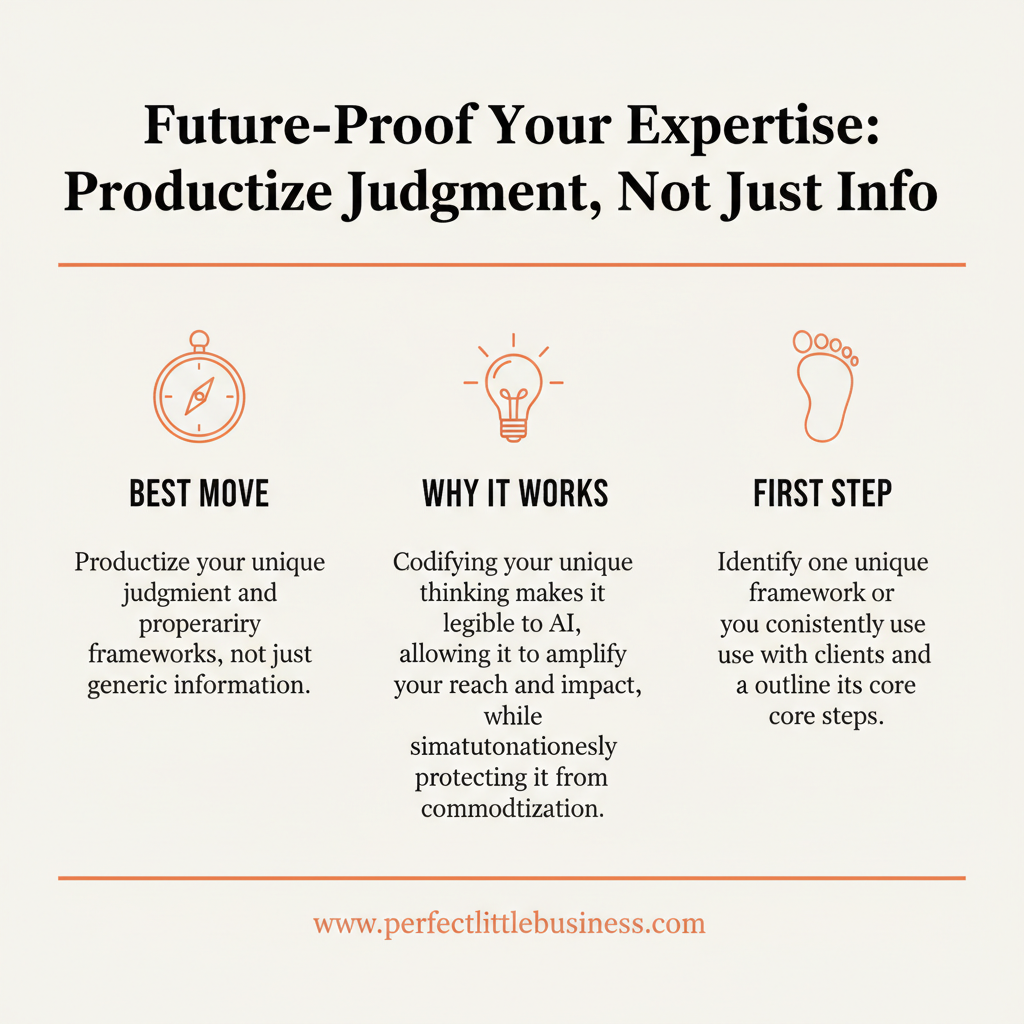
- Productizing your unique judgment creates a defensible asset that AI can amplify, not replace.
- AI rewards structured expertise; productization provides this essential structure.
- The risk of devaluing comes from productizing generic information, not proprietary thinking.
- Productized expertise allows you to scale impact beyond your direct time, increasing overall value.
- Your unique perspective and synthesis are what AI cannot replicate, and these are what you should productize.

See how AI understands your expertise
The AI Alignment Reading reveals where you are visible, where you are missing, and what to fix first.
Get Your AI Alignment ReadingHow does productizing expertise protect it from AI commoditization?
Productizing expertise protects it by turning your unique judgment and proprietary frameworks into structured intellectual property that AI can recognize and recommend, but not replicate [1].
The Mechanism
- Legibility: AI systems understand and categorize structured data. Your productized framework becomes a distinct data point.
- Differentiation: Generic information is easily replicated by AI. Your unique synthesis, methodology, and perspective are not.
- Leverage: Once codified, your expertise can be delivered at scale, reaching more people without proportionally more of your time, increasing its overall market value [2].
Example
If you productize a unique 5-step client onboarding process, AI might recommend your process as a solution, but it cannot invent your specific insights or the nuances of your methodology.
What kind of expertise is most suitable for productization in the AI era?
Expertise that involves unique judgment, proprietary frameworks, and a distinct methodology is most suitable for productization in the AI era [2].
Key Characteristics
- Unique Synthesis: Your ability to connect disparate ideas or solve problems in a novel way.
- Proprietary Process: A specific step-by-step method you've developed and refined.
- Distinct Perspective: Your unique lens through which you view and solve client challenges.
What to Avoid Productizing
- Generic Information: Facts, definitions, or basic how-to guides easily found via a quick search or AI query.
- Commoditized Skills: Tasks that AI can perform with high accuracy and efficiency (e.g., basic data entry, simple content generation). Productize your 'why' and 'how,' not just the 'what.'
How can I ensure my productized expertise is amplified by AI, not replaced?
To ensure your productized expertise is amplified by AI, focus on making it highly legible, structured, and distinct from generic information [1].
Strategic Steps
- Codify Uniqueness: Clearly articulate what makes your framework or methodology unique. Use specific terminology.
- Structured Content: Present your productized expertise in clear, organized formats (e.g., documented processes, diagrams, specific steps).
- Consistent Messaging: Ensure your unique value proposition is consistently communicated across all your digital touchpoints, making it easy for AI to 'understand' you.
- Solve Specific Problems: Design your productized offering to solve a very specific, high-value problem that requires human judgment. By doing this, AI acts as a recommendation engine for your specific solution, rather than generating a generic answer that bypasses you.
What are the common mistakes when productizing expertise that lead to devaluing?
The most common mistake is productizing generic information or commoditized services that AI can easily replicate or improve upon, rather than your unique judgment or proprietary frameworks [2].
Pitfalls to Avoid
- Information Overload: Offering vast amounts of uncurated information without a clear framework or unique perspective.
- Focusing on 'What' Not 'How': Selling basic knowledge instead of your unique process for applying that knowledge.
- Lack of Differentiation: Creating products that are indistinguishable from what competitors or AI tools can offer.
- Ignoring AI's Strengths: Attempting to productize tasks where AI excels (e.g., basic content generation, data analysis) instead of focusing on areas requiring human insight and synthesis. These mistakes lead to offerings that are perceived as low-value and easily replaceable.
Does productization mean losing the 'human touch' or personalization?
Productization does not inherently mean losing the 'human touch' or personalization; instead, it allows you to scale your unique insights while freeing up time for higher-value, personalized interactions [3].
How to Maintain Personalization
- Hybrid Models: Combine productized core content with personalized coaching or implementation support.
- Strategic Touchpoints: Identify key moments where human interaction is critical and design your product to facilitate these.
- Focus on Judgment: Productize the 'how' and 'why' of your expertise, which are deeply human, rather than the rote 'what.'
- Client Journey Design: Ensure the productized elements enhance the client journey, allowing you to focus your human energy on bespoke problem-solving and relationship building. By structuring your expertise, you can serve more people with your unique approach, often leading to a more impactful and focused human connection when it matters most.
Most experts fear productizing their expertise because they confuse 'product' with 'commodity.' They worry that if their genius is put into a box, it will lose its magic. But the opposite is true: unstructured genius is easily overlooked by AI, while structured genius becomes an asset AI can amplify. The future belongs to those who can articulate their unique thinking so clearly that AI can understand and recommend it, not just to those who can perform tasks AI can also do. This isn't about creating generic courses; it's about encoding your unique operating system for solving problems.
This is exactly what we help our clients do at Perfect Little Business.

Founder, Perfect Little Business
Cindy Anne Molchany is the founder of Perfect Little Business. Since 2015, she has designed and built over 70 online programs for clients that have collectively generated more than $100 million in revenue. She helps established expert founders build intelligent, human-first businesses that attract ideal clients, command authority, and create leverage — without performing for algorithms or chasing endless scale.